







Home > Wuyue Charm > History
History
Located in the town of Hongshan under the New District of Wuxi, Hongshan Hill, also known respectively as Woniushan (Crouching Ox Hill) and Tieshan (Iron Hill) in ancient times, runs from east to west with a length of more than 1,200 meters and a height of 80-odd meters. Owing to the fact that Taibo, the founder and the first ancestor of the state of Wu, was buried on the southern foot of the hill, it consequently became known as Guhuangshan (Ancient Sovereign Hill). Liang Hong, a well-known hermit in the Eastern Han Dynasty, came to live in seclusion with his wife at the foot of the hill and was later buried at the hillside. After his death, the name of the hill was changed to Hongshan in his memory.
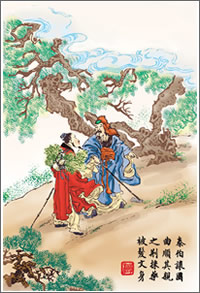
Hongshan is a well-known hill with the highest concentration of classical allusions in the area south of the Yangtze River. On the hillside, historical and cultural relics such as the tombs for Zhuanzhu and Yaoli, the two men being among the four famous assassins during Spring & Autumn and Warring States Period, Wangyu Pavilion (Looking-far-into-the-distant-Yu-Hill Pavilion), Jinbei Pavilion (Pavilion with a stele inscribed with administrative orders prohibiting lumbering,grazing and damaging vegetation on the hill ), among others, can be found and are called, together with the Taibo Mausoleum, the Eighteen Scenes of Hongshan.
